
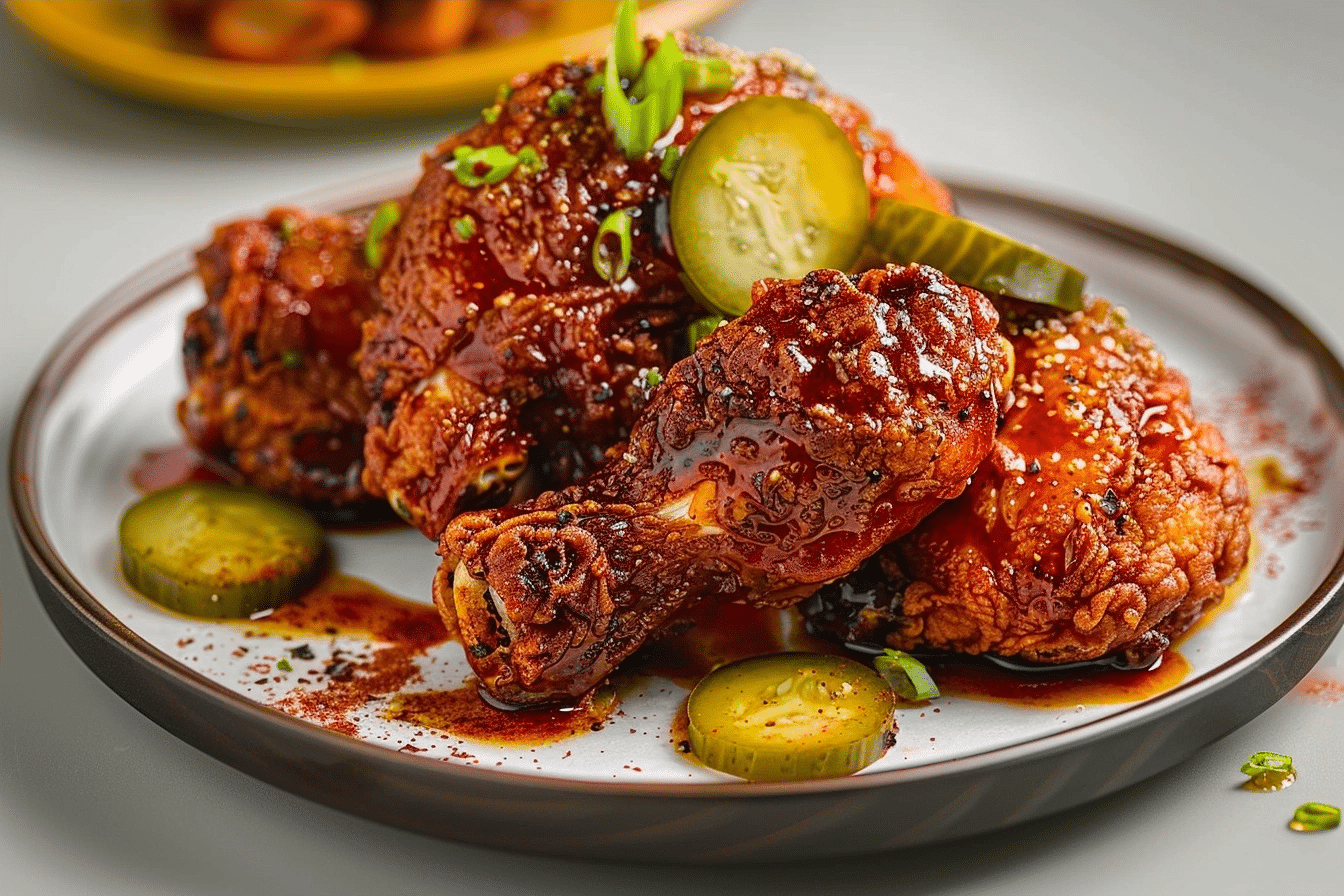
The BEST Nashville Hot Chicken Recipe ONLINE! is a spicy, vinegar-forward fried chicken dish from Nashville that pairs crisp, seasoned crust with juicy meat, served on white bread with pickles for contrast. This recipe produces reliably crunchy skin, a layered cayenne oil heat, and tender, well-rested meat after a two-stage fry and a bold spicy finish.
| Prep Time | 12-24 hours (marinate) + 30 mins active |
|---|---|
| Cook Time | 22-30 minutes per batch |
| Total Time | 12-24 hours 1 hour (including resting) |
| Servings | 4 (1 half per 2 people or 8 tenders) |
| Difficulty | Intermediate |
| Cuisine | Southern / American |
Image ALT text suggestion: Tray with marinated chicken halves soaking in buttermilk and spices.
Why This Recipe Works
This recipe works because it layers flavor, texture, and temperature control to create authentic Nashville hot chicken at home.
I rely on a buttermilk-hot sauce brine to tenderize and season the meat deeply, then a seasoned flour and a two-stage frying method to lock in moisture while building a light, crackling crust. The final cayenne-spiked oil brushed over the hot chicken adds a bright, late-hit heat and glossy finish that distinguishes Nashville-style chicken.
From my experience, the combination of a 12-24 hour marinade and the rest period between fries stabilizes the crust and prevents grease absorption, so the chicken stays crisp for serving. I use beef tallow for the spicy oil when I want depth, and I always cook in small batches to preserve oil temperature and consistent browning.
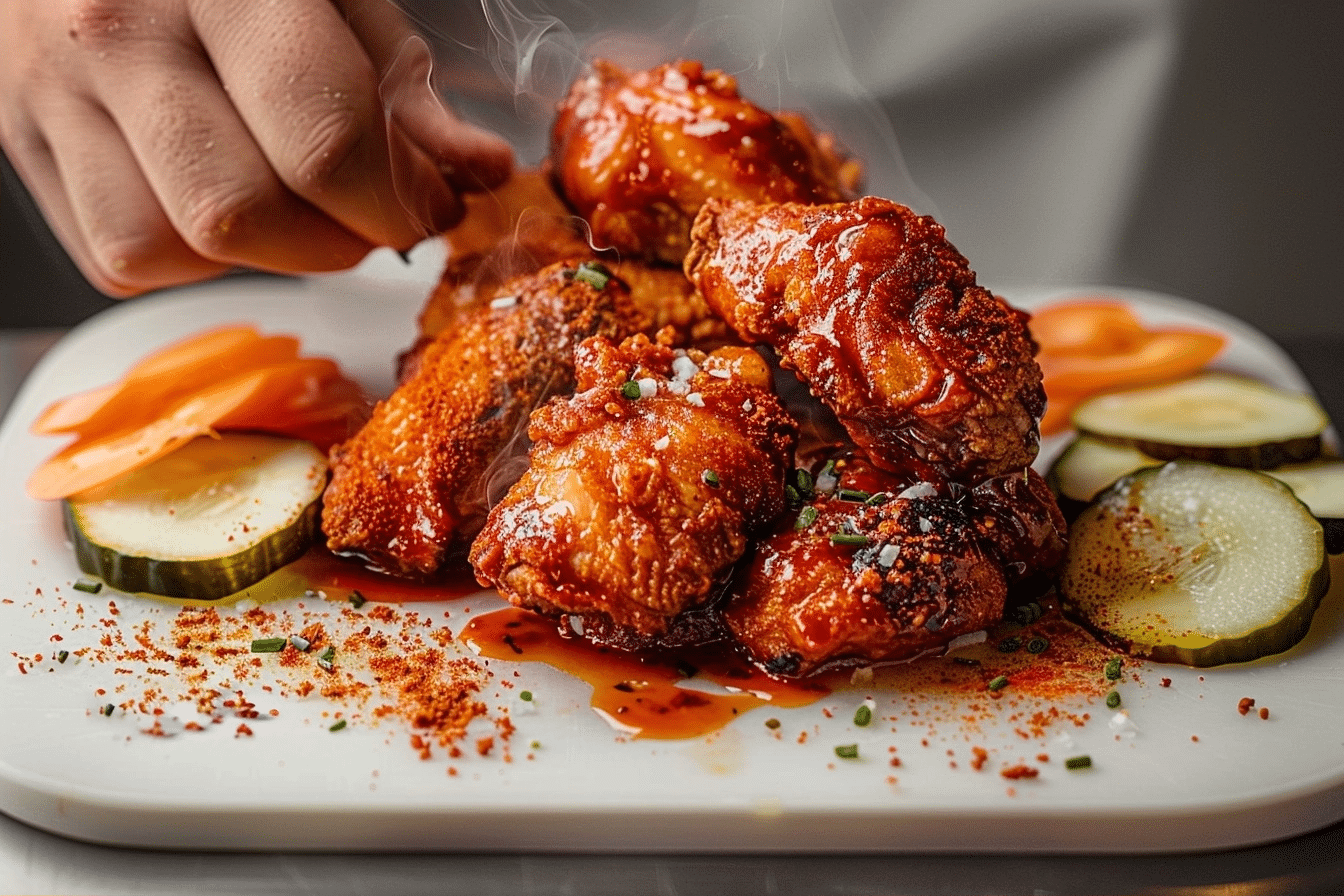
Image ALT text suggestion: Cook’s hands brushing spicy cayenne oil over freshly fried chicken on a wire rack.
Ingredients
These ingredients create the classic Nashville hot flavor and crisp texture.
| Ingredient | Quantity | Notes/Alternatives |
|---|---|---|
| Whole chicken, cut into halves (or 1 kg tenders) | 1 whole (cut into 2 halves) or 1 kg tenders | Use bone-in halves for best flavor; tenders cook faster. |
| Salt (total) | around 30g (1.05 oz) | Distributed across brine and flour mixes; adjust to taste. |
| Ground black pepper (total) | around 12g (0.42 oz) | Freshly ground gives brighter flavor. |
| Garlic powder (total) | around 6g (0.21 oz) | Use granulated garlic if preferred. |
| Cayenne pepper (total) | around 20g (0.70 oz) | Add more for higher heat; keep extra for spicy oil mix. |
| Brown sugar (total) | around 12g (0.42 oz) | Balances heat in the spicy oil mix. |
| Buttermilk | 600ml (20 fl oz) | Full-fat buttermilk for best tenderizing; yogurt + milk works as substitute. |
| Hot sauce (vinegar-based) | 40ml (1.4 fl oz) | Tabasco or similar; adds tang and heat to brine. |
| Eggs | 2 | Helps the flour adhere; whisk before adding to brine. |
| Beef tallow (sub for lard) | 200g (7 oz) | Use beef tallow or vegetable shortening if avoiding pork-derived fats. |
| Flour | 180g (6.3 oz) | All-purpose flour; rice flour adds extra crispness. |
| Peanut oil for frying | 3L (101 fl oz) | High smoke point; sunflower or canola are safe alternatives. |
| Sliced white bread, pickles, fries | To serve | Slices of soft white bread and dill pickles are traditional. |
Image ALT text suggestion: Ingredients arranged on a prep table: buttermilk, spices, flour, eggs, and chicken halves.
Step-by-Step Instructions
Follow these steps to marinate, coat, fry, and finish the hot chicken precisely.
Marinating
- Mix 2 tsp salt, 1 tsp ground black pepper, 1 tsp garlic powder and 1 tsp cayenne pepper in a small bowl to make the buttermilk marinade spice mix.
- Combine the buttermilk, hot sauce, 200ml water, eggs, and the buttermilk marinade spice mix in a large bowl and whisk until uniform.
- Add the chicken halves or tenders to the buttermilk mixture, ensuring pieces are fully submerged.
- Refrigerate the covered bowl and marinate for 12-24 hours to tenderize and infuse flavor.
Coating and Resting
- Mix 2 tsp salt, 1 tsp black pepper, 1 tsp garlic powder and 1 tsp cayenne pepper into the flour to create the flour spice mix.
- Remove the marinated chicken from the buttermilk and allow excess to drip off; reserve the marinade as needed.
- Coat each piece thoroughly in the seasoned flour, pressing to adhere a thick layer of flour on the surface.
- Leave the coated chicken on a wire rack for 20 minutes to hydrate the flour and maximize adhesion.
First Fry
- Preheat peanut oil in a deep fryer or large heavy pot to 140°C (284°F) and monitor with a thermometer.
- Cook the chicken in small batches to avoid overcrowding and maintain oil temperature.
- Fry each chicken half for 16 minutes at 140°C (284°F) until the exterior begins to set but not deeply browned.
- Remove pieces to a wire rack and let them cool undisturbed for 20-30 minutes to rest and equalize internal juices.
Spicy Oil and Finishing Fry
- Mix 8 tsp cayenne pepper, 3 tsp brown sugar, 3 tsp ground black pepper and 3 tsp smoked paprika in a heatproof bowl to make the spicy oil mix.
- Heat the beef tallow in a small pot to 160°C (320°F) until just shimmering.
- Carefully pour the hot tallow over the spice mix, stir thoroughly, and set the spicy oil aside near the fryer.
- Increase the frying oil temperature to 165°C (329°F) and fry the rested chicken halves for an additional 6-7 minutes until golden brown and crisp.
- Remove the chicken to a wire rack and immediately brush or spoon the spicy oil liberally over each piece to coat the skin while hot.
Tenders Option
- Cook tenders in the preheated oil at 165°C (329°F) for 6-7 minutes until golden and cooked through.
- Drain tenders on a wire rack and apply the spicy tallow-based oil immediately to maximize adhesion of the spice.
To Serve
- Arrange slices of white bread on a platter, place the hot chicken halves or tenders on top, and add dill pickle slices over the chicken.
- Serve immediately with hot fries on the side and extra spicy oil or ranch for dipping.
Image ALT text suggestion: Finished Nashville hot chicken halves on white bread with pickles and fries on the side.
Chef Tips for Perfect Results
These chef tips ensure crisp, safe, and deeply flavored Nashville hot chicken every time.
- Control oil temperature carefully: keep the first fry at 140°C to cook through gently, then raise to 165°C for color and crispness. Use a probe thermometer to confirm stability.
- Use small batches to prevent temperature drop; a 20-30% temperature loss will make the crust greasy and soft.
- Rest the chicken between fries on a wire rack, not paper towels, to avoid steaming the crust and to let juices redistribute.
- Make the spicy oil with tallow or neutral oil and pour it hot over spices for maximal bloom; stir immediately to release aroma and dissolve sugar.
- Press the flour onto the wet chicken for a thicker crust that stays attached after frying. A 20-minute hydration step improves adhesion.
- Season incrementally: distribute salt across brine and flour rather than salting only at the end to avoid over- or under-salting.
Image ALT text suggestion: Close-up of a chef testing oil temperature with a thermometer above a pot of hot oil.
Common Mistakes to Avoid
These common mistakes cause soggy crusts, undercooked meat, or muted flavor; here is how to fix each.
- Frying too hot or too cold: Frying too cold absorbs oil and makes the crust greasy; frying too hot burns the exterior before the center cooks. Fix by monitoring with a reliable thermometer and adjusting burner to maintain intended temperatures.
- Skipping the rest between fries: Removing the rest yields a loose, crumbly crust and uneven internal temperature. Prevent this by cooling on a wire rack for 20-30 minutes to stabilize juices and crust.
- Insufficient flour adhesion: Light dusting leads to thin, flaky crust that falls off. Press the seasoned flour firmly and allow a 20-minute hydration step to set the coating.
- Poor spice bloom: Adding spices cold to oil yields muted heat and aroma. Bloom spices by pouring hot tallow over them and stirring to release oils and dissolve sugar.
- Overcrowding the fryer: Crowding reduces oil temperature and causes uneven browning. Cook in batches and preheat oil between batches if needed.
Image ALT text suggestion: Overcrowded fryer basket with oil splatter indicating improper technique.
Variations and Substitutions
These substitutions let you adapt the recipe for dietary preferences while maintaining solid flavor and texture.
| Ingredient | Substitution | Flavor/Texture Impact |
|---|---|---|
| Beef tallow (for spicy oil) | Vegetable shortening or grapeseed oil | Less beefy depth, still good heat; use neutral oil for a cleaner spice note. |
| Buttermilk | Plain yogurt thinned with milk | Similar tang and tenderizing action; slightly thicker texture unless thinned. |
| Peanut oil | Sunflower or canola oil | Comparable frying performance; slight difference in mouthfeel and aroma. |
| All-purpose flour | Rice flour or a 50/50 blend with cornstarch | Crisper, lighter crust; may brown faster so watch closely. |
Image ALT text suggestion: Small bowls showing alternative oils, flours, and thickeners for variations.
Serving Suggestions and Pairings
These serving ideas match the spicy fried chicken with complementary sides, drinks, and occasions.
- Serve the hot chicken on sliced white bread with dill pickles and a side of hot fries for an authentic presentation.
- Pair with creamy coleslaw, buttermilk biscuits, or mac and cheese to balance heat and add texture contrast.
- Offer cooling dips like ranch, blue cheese, or a yogurt-cucumber sauce for guests who want relief from heat.
- Serve with iced sweet tea, lemon soda, or a citrusy non-alcoholic spritzer to cleanse the palate.
- Present this dish on game day, casual dinner parties, or celebrations like Memorial Day and Fourth of July for its crowd-pleasing impact.
Useful recipes: best frying techniques, crispy coating tips, southern side dishes.
Image ALT text suggestion: Platter served with Nashville hot chicken on bread, pickles, fries, and a glass of iced tea.
Storage and Reheating
These storage and reheating methods keep the chicken safe and preserve crispness when possible.
| Method | Duration | Instructions |
|---|---|---|
| Refrigerate | 3-4 days | Cool to room temperature on a rack, transfer to an airtight container, reheat in oven at 175°C (350°F) for 10-15 minutes. |
| Freeze | Up to 3 months | Fully cool, wrap each piece tightly in foil and place into a freezer bag; thaw overnight in fridge before reheating. |
| Reheat for crispness | 10-15 minutes | Preheat oven to 190°C (375°F) or use an air fryer at 180°C (356°F) to restore crisp texture; brush with reserved spicy oil after reheating if desired. |
Image ALT text suggestion: Leftover Nashville hot chicken stored in a container next to an oven tray for reheating.
Nutritional Information
These approximate nutrition values reflect one serving of chicken halves with bread and pickles; values will vary by portion and exact ingredients.
| Nutrient | Amount per Serving |
|---|---|
| Calories | Approx. 850 kcal |
| Protein | Approx. 45 g |
| Fat | Approx. 60 g |
| Carbohydrates | Approx. 28 g |
| Fiber | Approx. 1 g |
| Sugar | Approx. 4 g |
| Sodium | Approx. 1500 mg |
Approximate values.
Image ALT text suggestion: Nutrition facts style card displayed beside a single serving of fried chicken.
Frequently Asked Questions
These answers address substitution, doneness, troubleshooting, make-ahead planning, and storage for Nashville hot chicken.
What is the best substitute for lard in Nashville hot chicken recipe?
The best substitute for lard in this Nashville hot chicken recipe is beef tallow or neutral vegetable shortening. Beef tallow provides a rich mouthfeel and carries spice well, while neutral shortening or grapeseed oil offers a cleaner flavor and still heats safely. Choose tallow for depth or vegetable fat for lighter aroma.
How do I know when Nashville hot chicken is cooked through?
You know Nashville hot chicken is cooked through when the internal temperature reaches 74°C (165°F) at the thickest part near the bone. Use a reliable probe thermometer inserted into the thickest section without touching bone for an accurate read. Also check that juices run clear and the meat pulls away from the bone slightly.
Why is my coating falling off Nashville hot chicken and how can I fix it?
The coating falls off when the flour does not properly adhere or when the piece is disturbed during early frying stages. Fix this by pressing the seasoned flour firmly into the wet chicken, allowing a 20-minute hydration period, and avoiding flipping until the crust sets. Maintain correct oil temperatures to prevent excessive movement or collapsing of the coating.
Can I make Nashville hot chicken ahead of time for a party?
You can make Nashville hot chicken ahead by completing the first fry and cooling the chicken on racks before refrigerating for up to 24 hours. Reheat in a 190°C (375°F) oven or air fryer to restore crispness and then apply the spicy oil immediately before serving. For larger events, finish the second fry and reapply spicy oil just prior to guests arriving to preserve peak texture.
How should I store Nashville hot chicken overnight for best texture?
Store Nashville hot chicken overnight by cooling completely on a wire rack and placing pieces in a single layer in an airtight container in the refrigerator. Avoid stacking in wet containers to prevent sogginess; re-crisp in a preheated oven or air fryer at 180-190°C (356-375°F) before serving. Keep spicy oil separate and brush on after reheating for best flavor retention.
Image ALT text suggestion: FAQ section illustration showing a thermometer and storage container next to fried chicken.
Conclusion
The BEST Nashville Hot Chicken Recipe ONLINE! delivers an authentic, reliably crispy, and boldly spiced fried chicken that stands up to tradition and home cooking. Follow the brine, two-stage fry, and hot spicy oil finish for true Nashville flavor, and use the chef tips and troubleshooting notes to perfect your result. Serve on white bread with pickles and fries and enjoy the bright, lingering cayenne heat.
Image ALT text suggestion: Final plated Nashville hot chicken with a glossy cayenne oil shine and pickles perched on white bread.
External resources: USDA, Serious Eats.
Nashville Hot Chicken
Ingredients
- Whole chicken (cut into halves or 1 kg tenders)
- Buttermilk
- Ground salt (30g total)
- Ground black pepper (12g total)
- Garlic powder (6g total)
- Cayenne pepper (20g total)
- All-purpose flour
- Vegetable oil (for frying)
- Beef tallow or halal alternative (spicy oil mix)
- Unseasoned rice vinegar or white vinegar
- Lemon juice
- Granulated garlic (optional)
- Hot sauce (optional, for extra heat)
- White bread
- Pickles
Instructions
- Prepare a buttermilk brine with salt, black pepper, garlic powder, and cayenne pepper
- Submerge chicken pieces for 12-24 hours in refrigerator
- Remove chicken, pat dry, and dredge in flour seasoned with remaining salt, pepper, and cayenne pepper
- Heat vegetable oil to 325°F in a heavy-bottomed pot
- Fry chicken in batches for 6-8 minutes until golden but undercooked inside
- Remove and let rest on wire racks for 15-20 minutes
- Reheat oil to 375°F and fry second time for 2-3 minutes until fully crispy
- Drain on wire rack, then brush with cayenne-spiked oil (mixture of melted beef tallow, 2 tbsp rice vinegar, 1 tbsp flour, and 1 tsp salt)
- Serve on white bread with pickles and lemon wedges
Notes
Can substitute buttermilk with a plant-based alternative for dairy-free
Use a cast iron skillet for even heat distribution
Chill chicken in ice water for 1h before frying for extra crisp
Extra cayenne oil can be stored in a sealed jar for 1 week